archived / shipped / access: artifacts
Fotbal Nadstavba Sim
A Monte Carlo experiment asking whether a proposed Czech football format could make losing on purpose the rational strategy.
- span
- 2017
- role
- simulation author · analyst
- audience
Context
This project was inspired by a newspaper article regarding a newly proposed competition format for the Czech football league that would introduce an additional stage after the double round-robin league phase. A feature of that system was that one of the teams finishing 7th-10th would secure a slot in European competitions (a prestigious perk traditionally awarded according to final league standing), while teams finishing 4th-6th would not get a slot.
From my point of view, that was a clear case of bad competition design, as it created an incentive for teams around 5th-6th place near the end of the league phase to intentionally throw matches and finish lower. This would allow them to enter a stage where they could compete for the desired slot against weaker teams.
In the interview, Svoboda (the league chief at that time) explicitly downplayed the possibility of such a strategy:
🇨🇿 Czech original
„A co by jim to přineslo za výhodu? Když tým skončí na šestém místě, tak v nadstavbové části bude hrát ještě o patnáct bodů. Takže má pořád reálnou šanci bojovat o Evropskou ligu nebo alespoň o baráž. Neumím si představit, aby rozdíl mezi šestým a pátým nebo čtvrtým týmem byl po základní části patnáct bodů. Ale když někdo začne špekulovat a raději skončí sedmý, tak se mu může snadno stát, že nakonec druhou skupinu nevyhraje a skončí osmý,“ namítl Svoboda.
🇬🇧 English translation
“And what advantage would that give them? If a team finishes sixth, there will still be fifteen points to play for in the playoff phase. They will therefore still have a realistic chance of qualifying for the Europa League, or at least reaching the qualification playoff. I cannot imagine the gap between the team in sixth and those in fifth or fourth being fifteen points after the regular season. But if someone tries to game the system and deliberately finishes seventh instead, they could easily fail to win the second group and end up eighth,” Svoboda argued.
This made me want to demonstrate that the issue was real and try to persuade some of the club higher-ups to reject the proposed structure.
What I Built
I ran a Monte Carlo simulation to explore how often opportunities for match throwing arose and whether doing so increased the chance of securing a slot. In other words, I wanted to see whether match throwing could, in game-theory terms, be a rational strategy in some cases.
I used Java to handle the simulations and Power BI to craft the visualizations and evaluate the expected flow of the competition. I crafted custom match simulation logic incorporating the different offensive and defensive strengths of teams and a home-team advantage. The formulas and parameters of team strengths were empirically tweaked so that the simulated league results fit commonly seen patterns—30 points being the relegation threshold, a tightly packed middle of the table, and an average of around 2.75 goals per match.
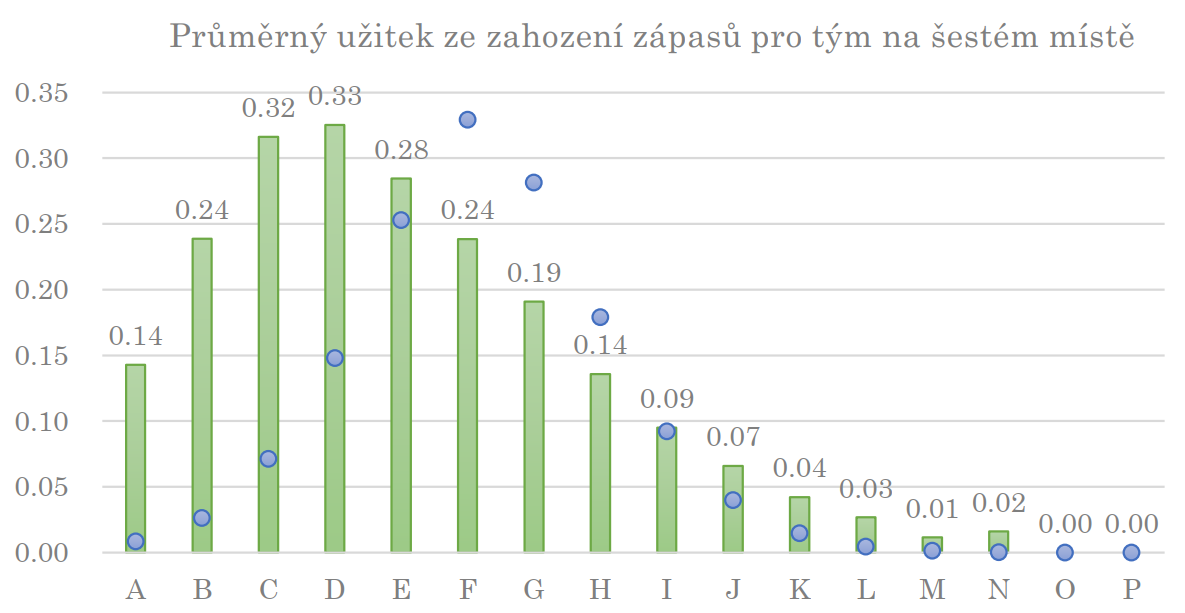
The experiment compared the default run with a situation in which the sixth-placed team opted to throw matches (simulated by multiplying the team's strength in the match by 0.25 and reducing scoring opportunities, since a loss cannot be guaranteed in practice). I imposed a limit: only strategies requiring at most the final three matches were considered in the simulation, reducing the decision space and keeping it realistic. I defined a utility function based on securing a European competition slot.
The main result was that 72.4% of simulated league runs provided an identifiable opportunity for match throwing—most frequently for the sixth-strongest team in the league. The average utilities of this strategy were non-negative for all teams, with the fourth-strongest team having the highest expected utility.
I summarized the findings in a PDF report that was sent to the secretariats of two league teams.
Interesting Problems
Utility definition
To evaluate the strategy, I had to define the utility function somehow. Securing a European competition slot is quite an obvious tangible boon for the team, but there are plenty of other nuances that were not incorporated and could play a role in the decision.
The prestige hit is an example of a negative utility that is quite hard to measure without deep sociological insight. It might very well be possible that the fans would take an all is well if it ends well approach and not care as long as it brought the desired outcome. It is also quite reasonable that some supporters would be turned off by such an action and would stop supporting the team or watching the sport altogether. To put that into more explicit terms: a prestige penalty worth one-third of the fourth European qualification slot would make throwing irrational for every team.
Finishing in a worse position would also reduce the money the team is awarded for its league placement. It would be quite difficult to calculate the exact loss or gain, as the money is split proportionally based on league funding, while participating in European competitions also provides money based on performance, achievements, and the team's coefficient.
I opted for a simpler utility model that only valued the slots, as the point was to demonstrate the strategy rather than estimate the exact worth or cost of such an action.
Related projects
- Tournament format simulator was started as a successor to this project that would be more general (not shoehorned into a particular competition) and could be used as an interactive tool to explain the intricacies to other people.
- SC2 Tour System partly dealt with tournament format optimization to maximize engagement for middle-of-the-pack and casual players rather than the title contenders.